What Is Plan in Civil Engineering Drawing
🕑 Reading time: 1 infinitesimal
Building plans are the fix of drawings which consists of floor programme, site plan, cross sections, elevations, electrical, plumbing and landscape drawings for the ease of structure at site. Drawings are the medium of passing the views and concepts of an architect or designer into reality.
Contents:
- Types of Building Plan Drawings
- one. Site Plan
- 2. Floor Plan
- iii. Cross Section
- 4. Acme
- one. External Elevation
- 2. Internal Elevation
- 5. Landscape Plans
Types of Building Program Drawings
Considering the detailing and complexity of a project, different types of drawings are issued by an builder for the easy understanding and smooth working of construction process. Some the types of drawings are discussed in depth beneath,
1. Site Plan
Site plan is comprehensive detailed drawing of the edifice or an apartment representing whole programme of a edifice. It shows holding boundaries and means of access to the site, and nearby structures if they are relevant to the design. For a structure projection, the site programme also needs to show all the services connections like drainage and sewer lines, h2o supply, electrical and communications cables, exterior lighting etc.

Fig one: Site Programme of a house.
Its a showtime design that is made for whatsoever project earlier going into detailing process. Drawing up a site programme is a tool for deciding both the site layout and the size and orientation of proposed new buildings. These drawings should comply with the local evolution codes, including restrictions on historical sites. It acts every bit a legal agreement for the permission of construction from the government torso. For this, it is required that the site plan is made by a licensed professional like architect, engineer, landscape builder or country surveyor.
2. Floor Program
A plan means, acme view of any building or object. Floor plan is the nearly fundamental architectural diagram, a view from above showing the arrangement of spaces in building in the aforementioned manner as a map, but showing the arrangement at a particular level of a edifice. Floor program view is defined as a vertical orthographic project of an object on to a horizontal plane cut through the building. This shows the walls, windows, door and other features such as stairs, fittings and even furniture too.

Fig ii: 2D Floor Plan.
Flooring plan is usually given in 2D form, which has all the measurements and detailing. At present a days for a better understanding and conceptualise the plan prior to the construction, floor plans are made in 3D where 1 can run across how the unabridged apartment looks with furniture from above, giving you a mode to see not only how objects fit in the space, merely how specific piece of furniture pieces look together.

Fig iii: 3D Floor Plan.
three. Cantankerous Section
Geometrically, a cross department is a horizontal orthographic project of a building on to a vertical plane cutting through the building. Cross section is vertical cut department of any building which shows the details of dimension, thickness of any component of a building. It also represents the sill height, lintel meridian, floor peak and other minute details of a construction.

Fig 4: Cross Section.
The section aeroplane where the plan is vertically cut is represented in the 2d flooring plan by a bold dotted straight line.
4. Superlative
An elevation drawing is an orthographic projection drawing that shows one side of the house. The purpose of an elevation drawing is to prove the finished advent of a given side of the house and replenish vertical height dimensions. Majorly it is divided into 3 types,
1. External Top
Outside elevation is the outside representation of a building. It consists of details of blazon of terminate, floor height and projections if any. Exterior elevations can be 2D or 3D drawings. 2D drawings typically have measurements on them, showing where the relationship betwixt exterior elements similar doors and lights. 2D elevations also can have callouts to unlike kinds of bricks, stones, and paints, so you know exactly where each fabric needs to go.

Fig v: 2D External Elevation.
3D exterior renderings are similar to their second counterparts, except they focus entirely on the visual. Well-nigh of the time, a rendering is a concept cartoon to take to whoever is constructing your projection to requite them an thought of what you want the exterior to expect like. From the concept, they'll create the detailed outside summit they need to build from.
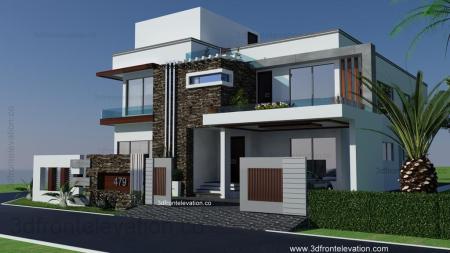
Fig 6: 3D External Elevation.
ii. Internal Pinnacle
Interior elevations are very similar to outside elevations in purpose. Elevations are extremely useful when constructing a room such as a kitchen or bathroom, which require visualisation of built in elements.

Fig 7: 3D Internal Summit.
Unremarkably interior elevations are made in 3D that show your furniture in your space. The inner elevation effects a lot on the living condition and peaceful mind. These days cracking importance is given to interior pinnacle than exterior tiptop. Interior elevation has the paint colour, lightning types, furniture pattern and floor patterns.
v. Landscape Plans
A perfect home or a building has a lush green garden adjacent to it, which enhances the dazzler or aesthetics appearance of the building. Hiring a landscape architect for the beautification of houses is trending at present a days.

Fig eight: Landscape Programme
On landscape plans, you'll see everything from flowers to sidewalks and backyard decorations to fountains. It majorly consists of sidewalks, plantations and other decorative features that can raise the living area. Read More: Types of Drawings used in Building Construction
Source: https://theconstructor.org/practical-guide/building-plans-types/24963/
0 Response to "What Is Plan in Civil Engineering Drawing"
Post a Comment