Picasso Was Influenced by Art Objects From in His Creation of Les Demoiselles Dã¢ââ¢avignon
Upturning the notions of convention and traditional modes of portrayal, Pablo Picasso's famous Young Ladies of Avignon, not to exist confused with the legendary Arthurian island of Avalon, has been regarded as one of the most important modernist paintings. This is the painting, otherwise known equally Les Demoiselles d'Avignon (1907), which we will explore in more particular beneath.
Table of Contents
- 1 Artist Abstract: Who Was Pablo Picasso?
- two Les Demoiselles d'Avignon by Pablo Picasso in Context
- 2.1 Contextual Assay: A Brief Socio-Historical Overview
- 3 Formal Analysis: A Cursory Compositional Overview
- 3.1 Subject Matter
- iii.ii Colour
- 3.3 Perspective and Form
- 3.4 Preparatory Sketches
- 4 Up Close and Personal
- five Frequently Asked Questions
- 5.1 Who Painted Les Demoiselles d'Avignon?
- 5.2 What Is the Les Demoiselles d'Avignon Significant?
- 5.three What Style Was Les Demoiselles d'Avignon Painted In?
Artist Abstruse: Who Was Pablo Picasso?
Pablo Ruiz Picasso was built-in in a city in Andalusia in Spain in 1881 on 25 October. His male parent taught art and mentored Picasso with foundational artistic skills. During Picasso's early teenage years he started formal schooling in art and around historic period 16 he attended Madrid'southward Real Academia de Bellas Artes de San Fernando. Picasso too traveled to places like Paris.
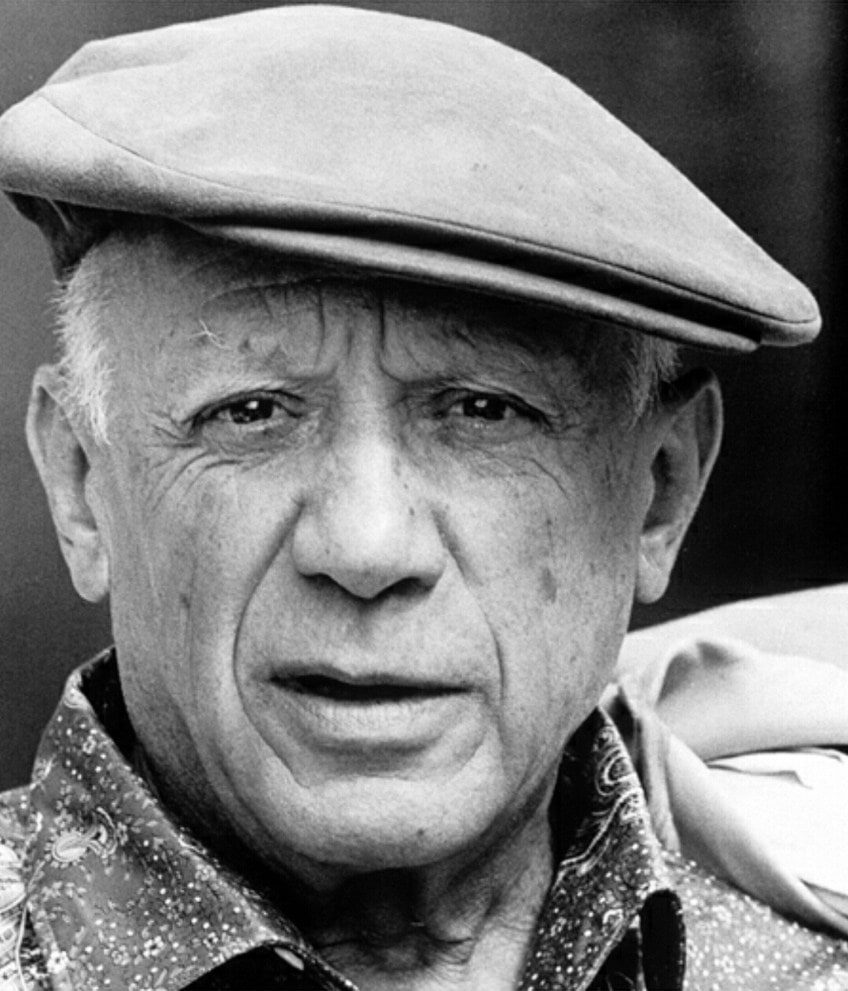 Portrait of Pablo Picasso, 1962; Argentine republic. Revista Vea y Lea, Public domain, via Wikimedia Eatables
He was acquainted with numerous notable artists like his swain Georges Braque and Julio González. Picasso'southward artistic oeuvre has been distinguished past various phases, namely, Blue Period (c.1901 to 1904), Rose Menstruation (c. 1905 to 1907), African-influenced Period (c. 1907 to 1909), and so Cubism Period, which consisted of Analytical (c. 1909 to 1912) and Constructed (c. 1912 to 1919). Picasso died from a pulmonary edema in Apr 1973.
Les Demoiselles d'Avignon by Pablo Picasso in Context
Les Demoiselles d'Avignon has often been regarded as the precursor to Cubism, identified as a Proto-Cubist painting; proto is a prefix that ways "first formed" or the earlier forms of something. Yet, this is not just whatever "proto" blazon of Cubist artwork, only a revolutionary depiction of art that signified the new Modern era.
In the commodity beneath, we will expect at the Les Demoiselles d'Avignon analysis, starting with a brief contextual background about why Picasso painted information technology and some of the influencing factors around the Les Demoiselles d'Avignon significant.
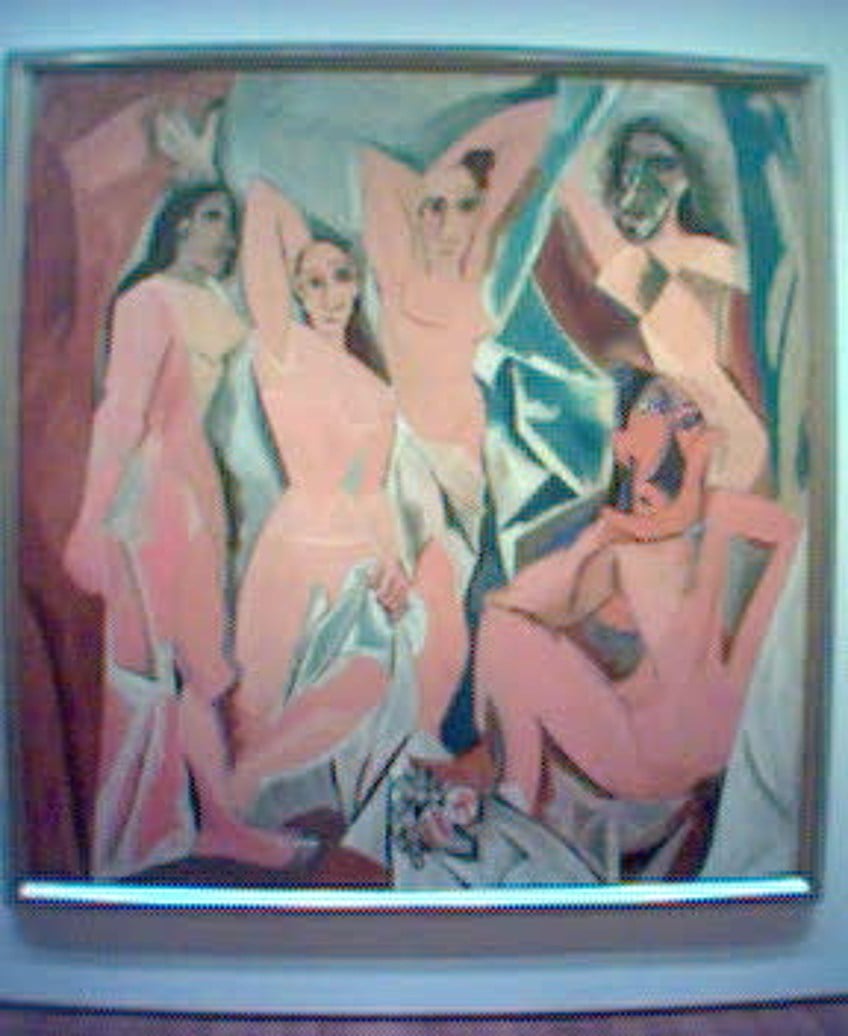 Les Demoiselles d'Avignon (1907) by Pablo Picasso;TenSafeFrogs, CC BY ii.0, via Wikimedia Commons
We volition and so discuss the formal analysis looking at the subject matter in more particular as well as Picasso's stylistic approach in terms of painting techniques and perspective, which is what makes this painting so unconventional and defiant for its fourth dimension.
| Creative person | Pablo Ruiz Picasso |
| Date Painted | 1907 |
| Medium | Oil on canvas |
| Genre | Genre painting |
| Catamenia / Motility | Proto-Cubism |
| Dimensions | 243.9 10 233.7 centimeters |
| Series / Versions | Not applicable |
| Where Is It Housed? | The Museum of Modern Fine art (MOMA) |
| What It Is Worth | Bought for $24,000 past the Museum of Modern Art |
Contextual Analysis: A Brief Socio-Historical Overview
In the painting, Les Demoiselle d'Avignon Picasso upended what was deemed traditional in painting, for instance, the more realistic portrayals of figures and natural environments. These also followed a set up of standards in the fine art that have existed since the Renaissance and upheld through the academic tenets of the French Academy throughout the 18th and 19th centuries.
These set of standards for how paintings were always expected to be created involved a three-dimensionality, depicting space and depth through various techniques like linear perspective and light and shadow, otherwise referred to equally chiaroscuro – techniques we accept all come up to empathize through the great masters of fine art like Leonardo da Vinci or Michelangelo from the Renaissance period. However, times accept inverse, and nosotros at present enter the 20thursday century, where artists are no longer expected to follow Classical rules.
Additionally, before Cubism came to be, the 19th century was dappled with divergent artists who digressed from following Classical traditions set out past the French Academy and the main exhibition institution known as the Salon in Paris.
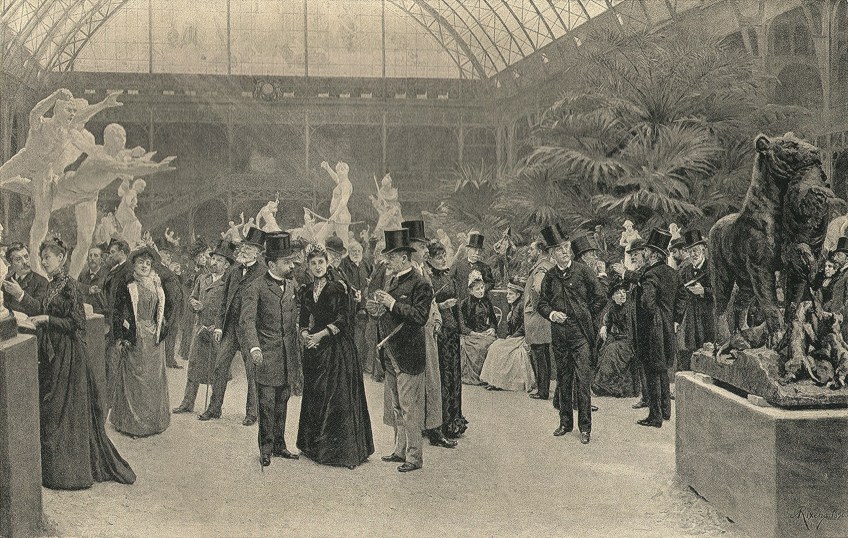 Formally dressed patrons at the Salon in 1890. Un Jour de vernissage au palais des Champs-Élysées past Jean-André Rixens featuring Tigresse apportant un paon à ses petits by Auguste Cain;Jean-André Rixens (1846-1925), Public domain, via Wikimedia Eatables
But what art movements came earlier Cubism, who were these divergent artists? A brief understanding of them volition aid in our understanding of how Pablo Picasso worked and was influenced. In that location were several important art styles that emerged subsequently Impressionism during the 19th century. Nosotros will use Impressionism every bit the baseline considering this was one of the offset fine art movements that turned away from traditional bookish art.
Mail service-Impressionism developed and had various styles inside it, most notably Neo-Impressionism with artists similar Georges Seurat who pioneered Pointillism. Other prominent art movements included Fauvism with pioneers like Henri Matisse and André Derain. The Fauves focused a lot on color and expression of this through subject thing, which bordered on abstraction.
Some of the forefathers that inspired not just Pablo Picasso, only numerous artists from the 19th and 20th centuries, were notably Vincent van Gogh, Paul Cézanne, and Paul Gauguin, all post-Impressionists who sought to convey new modes of representation through color and brushwork.
Cézanne's approach to creating artworks was more analytical and he planned his paintings, unlike the en plein air approach of the Impressionists. He combined colors, forms, and how they interacted, additionally this application of color was non true to nature.
Matisse was widely quoted every bit saying that Cézanne was "the father of us all". The oil on canvass The Large Bathers (Les Grandes Baigneuses) (1898 to 1905) was one of Cézanne'southward famous artworks and would continue to be an emblem for artists like Pablo Picasso and Henri Matisse.
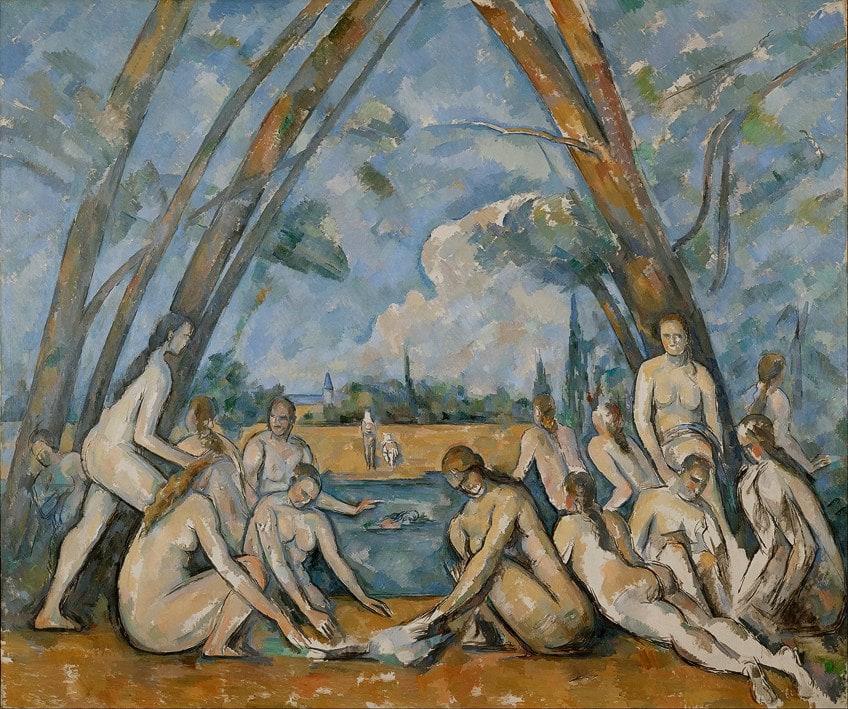 The Large Bathers (1906) past Paul Cézanne;Paul Cézanne, Public domain, via Wikimedia Commons
So, when Cézanne's The Big Bathers was exhibited in 1907 equally office of an honorary exhibition for the and then-deceased creative person, this influenced Picasso's manner. Information technology was non just Cézanne that influenced Picasso, merely when Matisse saw The Big Bathers, he set out to paint something quite like, his famous and radical oil on sail, Bonheur de Vivre (Joy of Life) (1905 to 1906).
Manifestly, Pablo Picasso had a competitive side to him and as a result, he created his ain painting in response to Matisse's above-mentioned painting. This said painting was the famed Les Demoiselles d'Avignon.
Artistic Influences: Picasso and Primitivism
This artwork was also painted in 1907 during Picasso'southward African flow, noted by the 2 women on the right who appear to be wearing masks. These we will discuss in the formal Les Demoiselles d'Avignon analysis further below. However, on a larger scale, we see the influence of Primitivism in Picasso's artworks.
Picasso was exposed to Primitivism during his artistic career and during the xixthursday century; Colonialism in various African countries led to the cribbing of cultural artifacts from African cultures that made their way to large European cities like Paris.
Picasso was manifestly influenced by the African masks he saw when he visited the Musée d'Ethnographie du Trocadéro, which was the ethnographic museum at the Palais du Trocadéro in Paris.
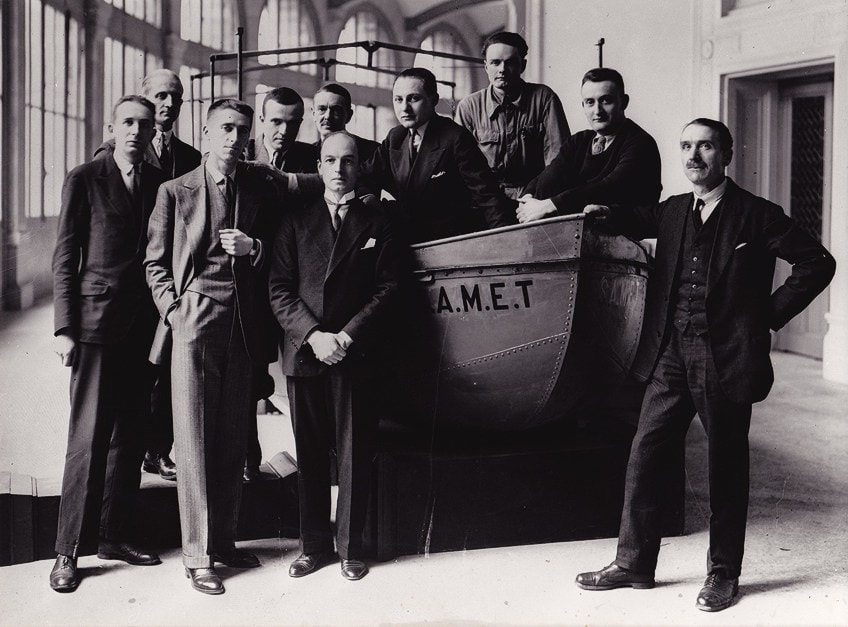 Members of the Dakar-Djibouti Mission at the Trocadero Museum of Ethnography, 1931; Charles Mallison, CC By-SA 3.0, via Wikimedia Commons
In 1907, when he spoke with Georges André Malraux, Picasso explained and has been widely quoted, about his visit to the ethnographic museum, "When I went to the Trocadéro, it was disgusting. The flea market. The smell. I was alone. I wanted to go away. But I didn't leave. I stayed. I stayed. I understood that it was very important: something happening to me, right?"
However, Picasso reportedly denied that these were an influence on his artwork. This has been a broad debate in the fine art world and maybe something he "subconsciously" depicted in Les Demoiselles d'Avignon.
More specifically, the African masks undoubtedly influenced Picasso. In fact, these were probably only triggers that catalyzed how he depicted Les Demoiselles, simply he was not directly paying homage to African masks.
It is also worthwhile knowing that, based on how the artist explained his visit to the ethnographic museum, he was seemingly simultaneously mesmerized and disgusted past the masks. They were from another globe, particularly for people living in Paris who did not have a point of reference other than a cultural museum.
Other than African masks, Picasso was also influenced past Iberian fine art and sculptures. It was Paul Gauguin'southward paintings and sculptures, which largely portrayed Primitivism, that left an impact on Picasso, notably one of Gauguin'due south exhibitions in 1906. Gauguin's ceramic sculpture Oviri (1894), which was also exhibited, was believed to have had an influence on the production of Les Demoiselles d'Avignon.
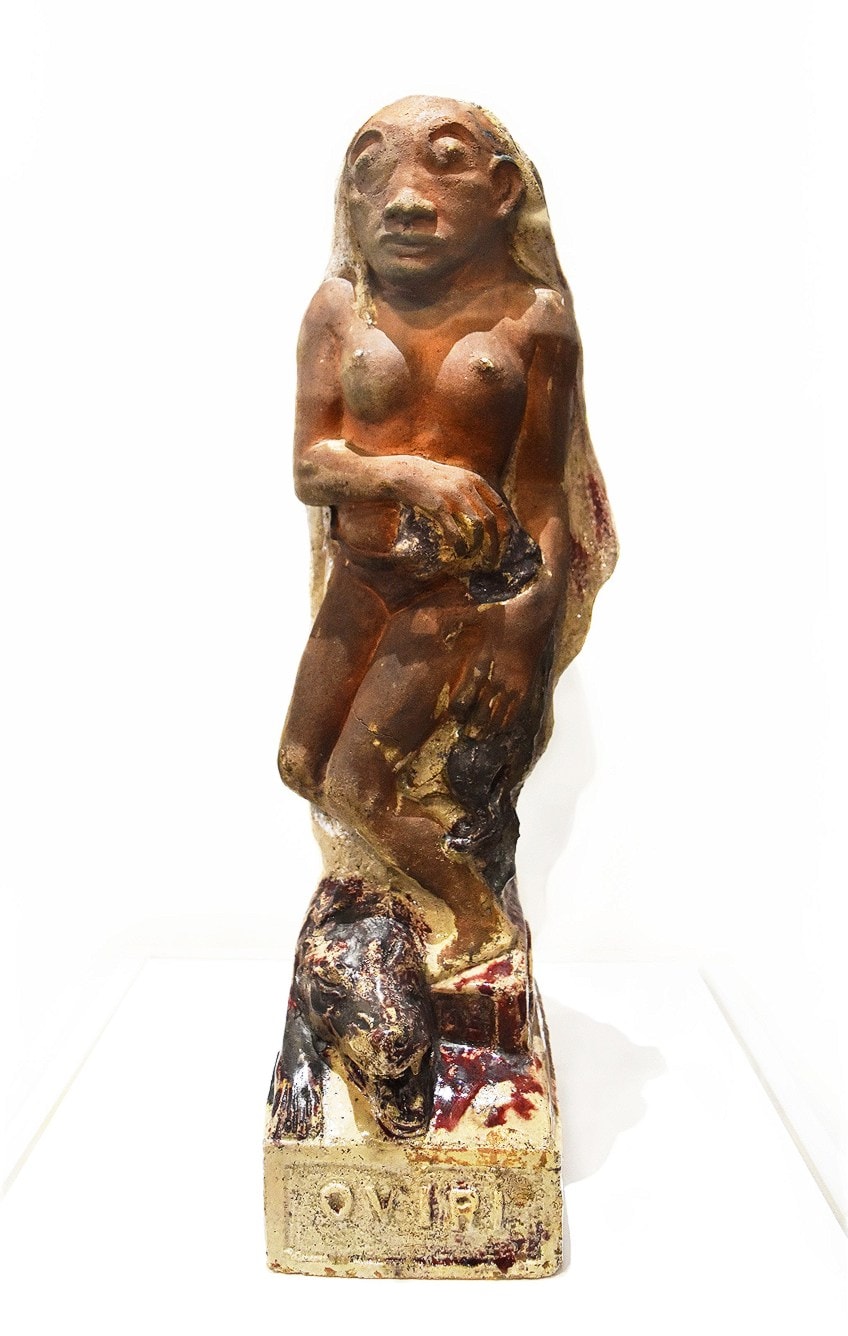 Paul Gauguin's Oviri (Sauvage) (1894). The theme of Oviri is death, savagery, wildness. Oviri stands over a dead she-wolf, while crushing the life out of her cub. Every bit Gauguin wrote to Odilon Redon, information technology is a thing of "life in death". From the back, Oviri looks like Auguste Rodin's Balzac, a sort of menhir symbolizing the gush of creativity; Coldcreation, Public domain, via Wikimedia Commons
Although there is much to say nearly Picasso and his attraction to Archaic art, what nosotros need to understand about this is that he seemed to exist enthralled by its "magic" if we can say that. He reportedly too collected these artifacts. Information technology was non merely Picasso that was enthralled, merely safe to say, many artists of the time found themselves viewing Primitive art walking the museums in Paris.
Prostitutes and a Brothel In Spain
What exactly is Picasso's Les Demoiselles painting almost? It depicts several prostitutes who were reportedly from a brothel in Barcelona in Spain on a street named Carrer d'Avinyó. Apparently, Picasso originally titled the painting Le Bordel d'Avignon (The Brothel of Avignon), but this was changed by André Salmon when it was exhibited for the offset time in 1916, several years after information technology was painted.
The new name that Salmon suggested was reportedly not something Picasso chose, but information technology was more than acceptable to present publicly and less sexually explicit. The bailiwick thing of prostitutes is some other large aspect of this painting and not a new blazon of subject matter; we see this explored in art centuries before.
A famous instance includes Titian'due south Venus of Urbino (1534), which shows a female nude quite graciously reclining and clearly, and quite coyly, becoming an object of sensuality for the onlooker. The manner Titian portrayed his Venus was perfectly traditional and adequate a way to depict the female nude.
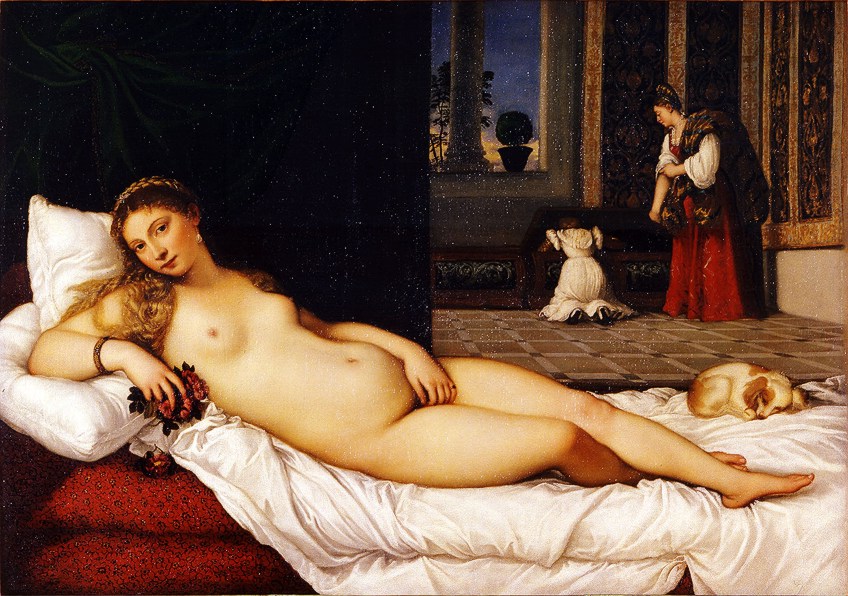 Venus of Urbino (1538) by Titian;Titian, Public domain, via Wikimedia Commons
When it came to Les Demoiselles d'Avignon Picasso certainly did not portray his female nudes in any traditional way whatsoever, not even stylistically according to formal elements of colour, line, or perspective. This was non the first fourth dimension a female person nude was portrayed in a non-traditional manner, if we expect back at Édouard Manet's Olympia (1863), information technology besides acquired a scandal because of its non-traditional approach to a very traditional subject.
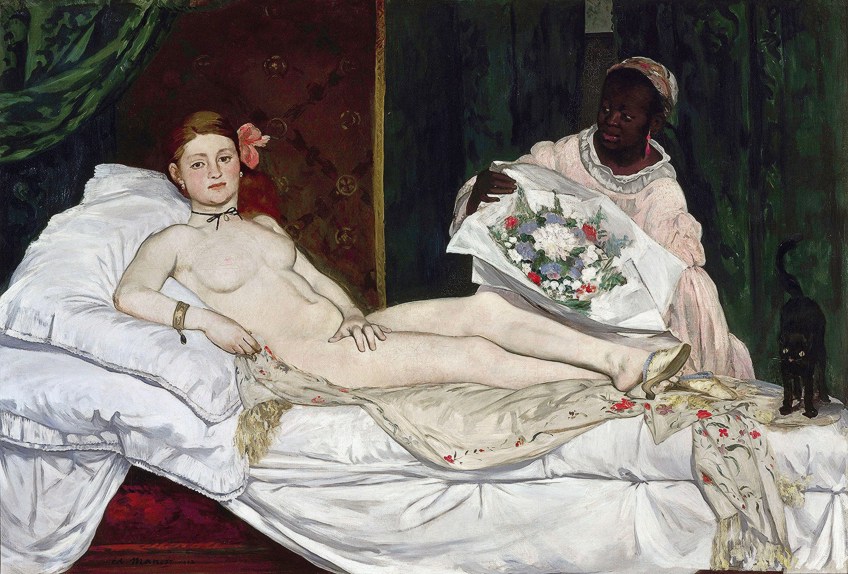 Olympia (1863) by Édouard Manet;Édouard Manet, Public domain, via Wikimedia Commons
Les Demoiselles d'Avignon was a revolutionary painting and not simply depicted the field of study that has been deemed as ideal dazzler pictorialized, but he also amalgamated it with the perceived "other", giving them a Primitive beauty that undoubtedly amalgamated the perceptions and notions of those who viewed it.
The Beginnings of Cubism?
Many believe that Les Demoiselles d'Avignon was a painting that gear up off the beginnings of Cubism, however, some scholars suggest that it is an "exaggeration". The work can be viewed every bit a precursor to what Cubism came to be and stylistically stand for. When nosotros wait at Les Demoiselles d'Avignon it will exist useful to proceed these aspects in mind and understand that it was non entirely Cubist, but as we mentioned earlier, Proto-Cubist.
Information technology hinted at the new ways Picasso would create artworks.
Formal Analysis: A Cursory Compositional Overview
Below nosotros take a closer look at Les Demoiselles d'Avignon and how Pablo Picasso set up the scene in terms of subject area affair, course, perspective, and so much more.
Discipline Matter
In Les Demoiselles d'Avignon Picasso presents united states with v nude women, four are standing and ane is sitting. The women are all looking directly at usa, the viewers. This was undoubtedly as well directed at the causeless client, which would have been a male visiting the brothel, and who would have equally gazed at these women to determine which one was more desirable for intimate liaisons.
The adult female to the left appears to stand up in profile, reminiscent of stances nosotros see in Egyptian art; additionally, her facial features resemble the same.
She has long nighttime pilus and her face is depicted in a dark earthier color compared to the rest of her trunk, which is a pinkish peach pare tone. We will also find her hand in a higher place her head, appearing to exist resting against the wall; her hand appears in the same browned color equally her face.
The adult female next to her looks directly at us, the viewers; her body is besides facing us. Her correct elbow (our left) is turned upwards as her correct paw rests behind her head. She holds a white sheet in her left mitt (our right), which is draped slightly over her left leg, which is slightly bent. We also notice her long brown hair behind her left shoulder (our right).
From this bending, information technology almost appears every bit if Picasso portrayed her to be viewed from ii perspectives, i from the forepart on and one from above because her body posture besides resembles someone lying down.
Similarly, the adult female adjacent to her, the tertiary from the left, has both easily behind her caput, her trunk is as well positioned as full frontal. Although hither the white canvas covers nearly of her lower torso area and we only see an indicative anatomical line on her lower left (our right) stomach area that leads to her genital area. Her hair is also brown and held up in a bun visible on her head.
When we motility to the right of the composition there are two women, one in the foreground sitting downwards, and one in the background, directly backside the woman sitting. Both women have facial features reminiscent of African masks.
We detect that these are not the aforementioned color as their skin tones, which are as well a pink-peach color as the other women. There are also more exaggerated stylistic details making their facial features, namely oversized noses, elongated oval-shaped faces, the woman at the dorsum has black almond-shaped eyes while the woman in front has 2 smaller almond-shaped eyes, the left is white, and the right is light blue, and small oval specs for mouths. The woman in front end is sitting in an overt style, both her legs are splayed open every bit she squats with her elbows resting on her knees.
This is some other aspect of Picasso'due south painting that makes it and so revolutionary for its time because he not simply portrayed five women confidently directing their gaze at us with their eyes only also with their bodies and genitalia.
In the lower heart portion of the composition, we run into various fruits arranged on what appears to be a tabular array. The white draped edges come across and point direct to the woman in the centre, almost leading our gaze into the scene and ultimately, into the brothel.
The background surrounding the five women appears to be a combination of white drapery or curtains, even so, Picasso painted this without a visible sense of depth, so nosotros are met with the adult female and their surroundings seemingly all as one.
Color
In Les Demoiselles d'Avignon Picasso utilized a neutral color scheme, we run into the dominant pink peach colors of the women's skin tones aslope the white and blue from what seems to be the curtain or sheets around them.
There are various hints of browns, to the left we see a brown construction, which could possibly denote a doorway or some other object in the room. We see areas of brown here and there, for example, on the table in the lower foreground, and various brown and black shadings around the women.
Picasso also uses thick outlines to propose contour lines on the women's bodies.
Perspective and Form
It is about as if perspective and form get together hither in Picasso'due south Les Demoiselles d'Avignon. His form informs the perspective, but it likewise adds to the unique quality of the painting and what makes and then many believe this as a forerunner to Cubism.
The forms Picasso used hither are primarily angular; we come across pointed projections that come from squares and ovular shapes. For case, the women'southward breasts appear cubic and triangular in course, especially the women to the left, in the back correct, and the adult female in the middle whose breasts appear more triangular.
We also meet this projected pointiness in the women'due south limbs similar their elbows and knees.
If nosotros wait at the white drapery that makes upwardly the background, merely also seems function of the foreground, Picasso also depicted this in a cubic fashion, separating the pall with lines and making it announced near disjointed, yet simultaneously joined equally one object.
This informs how Picasso too utilized perspective, he joined the foreground with the background and some sources describe it nigh creating a "claustrophobic" interior space. There is almost no three-dimensional quality, which is a dominant characteristic of this painting, and function of what is and so different and against the grain of traditional nude paintings.
Preparatory Sketches
Picasso plainly made numerous preparatory sketches, 1 of these has been widely studied. It depicts 2 men in the scene, there was one with a textbook in his hand to the left of the composition, believed to exist a medical pupil, and a man sitting in the middle who was believed to exist a sailor.
Picasso decided to exclude these figures in the original painting, however, information technology has been widely debated what the Les Demoiselles d'Avignon meaning would be if these men were in the scene. Would it accept taken abroad the accent on the women and their seeming independence and confidence as nude women, gazing at the viewer? Would it take also taken away the one-pointed focus the women had on the viewer?
There is much debate over whether the men represented Picasso'southward ideas or perspective of women, as he reportedly had a complex view of women, which undoubtedly influenced how he presented women and their qualities.
Upwardly Shut and Personal
Les Demoiselles d'Avignon was received with mixed feelings when information technology was exhibited. Many believed it was scandalous and lacked morality. It was overt in depicting sexuality and essentially sensuality. Still, it has been touted equally one of the virtually "influential" paintings in fine art and continues to inspire artists with its not-traditional and up-close-and-personal confrontation. Some of Picasso's later paintings include his famous oil on sail made in 1937 titled Guernica. Information technology has been described as a pioneering "anti-state of war" painting about the Spanish Civil War and when the boondocks called Guernica was bombed.
Picasso fabricated his mark every bit one of the leading artists of the Mod era and would continue to influence art movements similar Abstract Expressionism.
Oftentimes Asked Questions
Who Painted Les Demoiselles d'Avignon?
Pablo Picasso, a Spanish artist, painted Les Demoiselles d'Avignon in 1907. Picasso was i of the founders and leading artists of the Cubism art movement during the twentyth century.
What Is the Les Demoiselles d'Avignon Pregnant?
Les Demoiselles d'Avignon depicts five nude females staring at the viewer. They are prostitutes from a brothel. In that location take been many debated meanings nigh this painting, simply many describe it every bit a and then-called aggressive portrayal of sexuality. Additionally, some scholars also posit that it was about Picasso's own fear of the implications of sexual activity and disease, as well as his sexual desires, which would take been met visiting a brothel.
What Mode Was Les Demoiselles d'Avignon Painted In?
Les Demoiselles d'Avignon has been described equally a Proto-Cubist painting considering of its stylistic details that were so reminiscent of Cubism's art way. Information technology was also painted during Picasso'southward African menstruation, and sources suggest his interest in Primitive art too influenced the painting, specifically African tribal masks, Iberian art, and Egyptian art.
Source: https://artincontext.org/les-demoiselles-davignon-picasso/
0 Response to "Picasso Was Influenced by Art Objects From in His Creation of Les Demoiselles Dã¢ââ¢avignon"
Post a Comment